Trane Furnace Repair in Pomona
No-fluff answer: Pomona Trane HVAC repairs Trane gas furnaces across Pomona and ZIPs 91766, 91767, and 91768, from Lincoln Park bungalows to Phillips Ranch tracts, so call us at (213) 449-4344 or book online. We read the LED flash code, then fix ignition, pressure-switch, inducer, flame-sense, and high-limit faults on XR80, S9V2, and XC95m units, with common parts in the $119 to $600 lane.
Key details
- Trane furnace lines serviced: XR80/XL80/XV80 (80%), S9X2/S9V2, XR95, XV95, and XC95m modulating (~97.3% AFUE).
- We diagnose by LED flash code: 2 lockout, 3 pressure switch, 4 high-limit, 7 gas valve, 8 flame sense, 9 igniter.
- Furnace repair lane: typical 2026 SoCal $119 to $600 for common parts; replacement $3,000 to $7,500.
- Service area: Pomona + Wilton Heights, Hacienda, Westmont, Ganesha Hills (91766-91768).
- In-warranty heat-exchanger claims referred to Trane authorized service first; we handle out-of-warranty labor.
- Diagnostic $79 to $200 credited toward an approved repair.
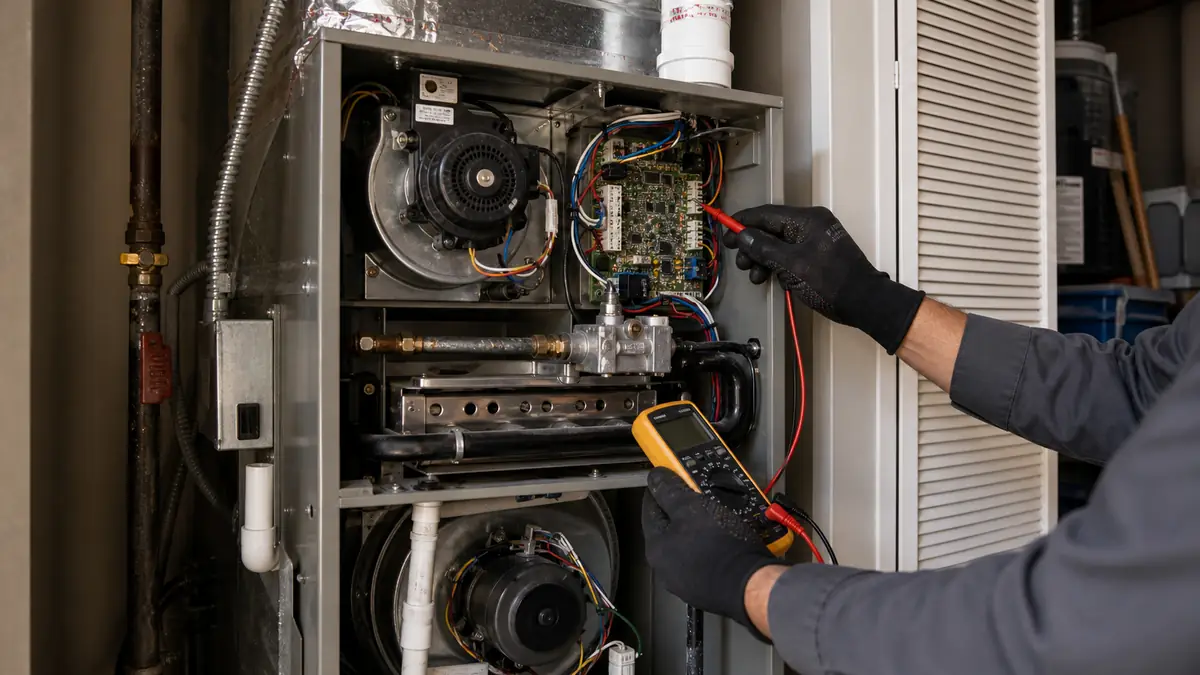
Why won't my Trane furnace ignite in Pomona?
Most no-heat calls trace to the ignition train, not the heat exchanger. On a Trane S-series or XR furnace, the integrated furnace control flashes a code on its status LED: a hot-surface igniter that has gone open-circuit (9 flashes), a flame sensor too dirty to prove flame (8 flashes), or a hard lockout after too many retries (2 flashes). After a Pomona summer of sitting idle, a varnished flame sensor is the single most common fix - a five-minute clean, not a board.
| LED flash code | Likely cause / first check | Cost lane |
|---|---|---|
| 2 flashes - system lockout | Ignition retries exceeded; check igniter, gas, flame sensor | $150 - $450 |
| 3 flashes - pressure switch | Inducer draft low or blocked flue; verify inducer amps and switch | $150 - $500 |
| 4 flashes - open high-limit | Low airflow from dirty filter, coil, or blower; clear restriction | $119 - $450 |
| 8 flashes - low flame sense | Dirty/varnished flame sensor; clean or replace | $119 - $300 |
| 9 flashes - igniter circuit | Cracked hot-surface igniter or wiring; replace igniter | $150 - $400 |
| 7 flashes - gas valve circuit | Gas valve coil or wiring fault; verify valve and harness | $300 - $900 |
| 5 flashes - flame sensed, none expected | Gas valve leak-by or board fault; inspect valve and IFC | $300 - $1,200 |
| 6 flashes - reversed polarity / grounding | 115VAC line polarity reversed or poor ground; correct wiring | $119 - $300 |
| Ignites, no air; normal heat call shown | Failed ECM blower module/motor; diagnose blower directly | $450 - $2,300 |
| Rollout trip, no relight (26-equivalent) | Possible cracked heat exchanger - safety condemnation | $3,000 - $7,500 |
Non-communicating XR and S-series furnaces report only by flash count, so we never replace a board on a guess - we meter the igniter resistance, the flame-sense microamps, and the inducer amp draw against spec. A communicating XV system with a ComfortLink II XL824 or XL850 instead spells the fault out in plain language on the screen and in the Trane Home app.
How does a Trane furnace repair actually go?
The sequence is the same whether it is a 1920s Lincoln Park bungalow or a Phillips Ranch tract. We start by reading the integrated furnace control (IFC) status LED - a slow flash is a normal idle, a fast flash is a normal heat call, and a counted pattern is the stored fault. We confirm 115VAC line power and correct polarity, then watch a full ignition cycle: inducer spins up and proves the pressure switch, the hot-surface igniter glows, the gas valve opens, and the flame sensor must prove flame within the trial-for-ignition window. Where it stalls tells us the part. We meter flame-sense current (a clean sensor reads several microamps; a varnished one reads near zero), check igniter continuity, test the pressure switch against inducer draft, and read the high-limit. Only then do we quote the flat repair. A dirty flame sensor cleans up in minutes; a cracked heat exchanger is condemned, never patched.
Which Trane furnace lines do you repair in Pomona?
All of the residential families, and which one you have changes the parts and the math:
- 80% AFUE single-stage (XR80, XL80, XV80): the most common Pomona furnace, since mild Zone 9 winters rarely justify more. Simple ignition train, cheapest parts, longest field history.
- 95-96% single-stage (S9X1, XR95): condensing furnaces with a secondary heat exchanger and a condensate drain that can clog - an extra failure point the 80% units do not have.
- ~96% two-stage (S9X2 constant-torque ECM, S9V2 variable-speed ECM): add a second gas-valve stage and a smarter blower; the S9V2's variable-speed ECM module is the pricier part if it fails.
- ~97% variable-speed (XV95) and ~97.3% modulating (XC95m): the flagship comfort tier with a modulating gas valve and full ComfortLink II communication, so faults surface as plain-language alerts rather than flash codes.
See the full lineup and tier tradeoffs on the Trane gas furnace page.
What does it cost to repair a Trane furnace in Pomona?
Common parts are affordable, and the bill breaks into a flat diagnostic (typical 2026 SoCal $79 to $200, credited toward the repair) plus the part-and-labor lane. A flame sensor clean or hot-surface igniter runs $119 to $400 installed, a pressure switch or inducer motor reaches $500, and a gas valve climbs to $300 to $900 because the part itself is dearer. A failed variable-speed ECM blower module - shared with the cooling side - is the expensive outlier at $450 to $2,300. A full furnace replacement, only when the heat exchanger is condemned or an 80% unit is stacking repeat repairs past 15 years, lands at $3,000 to $7,500 depending on tier. We quote the flat repair before we open the gas valve, and we never price-pad a $150 igniter into a system sale.
Why do Pomona furnaces fail the way they do?
It is a cooling-dominant city, so the furnace sits idle through a long, dusty summer and then gets asked to run on the first 40-degree November night. That idle stretch is exactly what varnishes a flame sensor and lets spiders or debris settle in an inducer or pressure-switch port - the two faults we see most on the first cold snap. The older Lincoln Park and Wilton Heights homes also run 80% furnaces shoehorned into tight closets and hallway platforms, where poor return airflow trips the high-limit (4 flashes) more readily. Newer Phillips Ranch and Ganesha Hills systems trend toward S9V2 and XC95m units whose condensate drains and communicating boards add modern failure points. A spring or fall maintenance visit heads off most of it.
When is a Pomona furnace worth replacing instead?
Two triggers: a confirmed cracked heat exchanger (a safety issue, not a repair) or an 80% unit past 15 years stacking repeat repairs. In mild Climate Zone 9, an 80% furnace like the XR80 is often adequate, so we rarely push a 97% XC95m unless you are already opening the system or chasing a SoCalGas furnace rebate (reported up to $600 on 92%-plus AFUE - verify the current amount). Walk the numbers on our repair-or-replace guide, or read the Trane gas furnace line page.
What about the blower and thermostat side?
A furnace that ignites but moves no air usually has an ECM blower or control fault, not a burner problem - the LED may show a normal heat call with no blower. If your system is communicating, a ComfortLink II XL824 or XL850 will surface a plain-language alert instead of a flash code. See ComfortLink II controls and our no-heat troubleshooting page for the full diagnostic path.
Common questions
What does a 3-flash code on my Trane furnace mean?
On a Trane integrated furnace control, three flashes is a vent/pressure-switch error - the inducer is not pulling enough draft, the flue is blocked, or the pressure switch failed. We verify the inducer amp draw and the switch closure before condemning a part. Common on Pomona homes after a long off-season.
Do Pomona homes really need furnace work if winters are mild?
Yes, just less often. Pomona nights still drop into the 40s, and an 80% furnace like an XR80 or XL80 that sat idle all summer often fails on the first cold snap - usually a dirty flame sensor (8 flashes) or a stuck inducer rather than a worn-out heat exchanger.
Is a cracked heat exchanger a repair or a replacement?
A confirmed cracked or rolled-out heat exchanger is a safety condemnation - we red-tag the unit and price a replacement, not a patch. If the furnace is under Trane's heat-exchanger warranty, we route you to authorized service first, then handle the labor-side install if you choose us.
Can you repair the furnace and tune the AC in one Pomona visit?
Yes. Since most Pomona Trane systems share a furnace blower with the AC coil, we can read furnace flash codes, test the ECM blower, and check the cooling side together so you are ready before the next 100 F stretch.
What does 4 flashes mean on my Trane furnace?
Four flashes is an open high-temperature limit - the furnace overheated and shut down for safety, almost always from low airflow. We check for a clogged filter, a dirty coil, a slipping or failed blower, and closed registers before replacing the limit switch itself, which is rarely the real fault.
How long does a Pomona furnace repair take?
Most single-part repairs - flame sensor, igniter, pressure switch, capacitor - close in one visit, often under an hour once diagnosed, because we stock those parts on the truck. An ECM blower module or gas valve may need a part order if your specific Trane model number is not on board that day.
Last updated 2026-06-13.